Do you work as a babysitter or plan to start soon? This guide explains Malaysia’s 2026 babysitting rates, average hourly pay, and real examples to help you calculate how much to charge based on your experience, city, and working hours.
Just started babysitting and not sure what to charge? Or maybe you’ve been at it for a while and want to know if your rate is fair? According to recent data from Sitly, a babysitter can earn anywhere between RM 15 and RM 30 per hour, depending on what you do and where you live. But this is only an average: the actual pay can vary widely based on your city, experience level, number of children, and the type of work involved. There are also general pay guidelines and common expectations that can help you understand how much you can earn as a babysitter in Malaysia.
In this guide, you’ll find everything you need to know to figure out how much to charge as a babysitter, how to calculate your hourly rate, and when it makes sense to ask for a higher wage. For more tips, check out our article on how to become the perfect babysitter.
How Much Does a Babysitter Earn per Hour?
If you work as a babysitter in Malaysia, your rate can vary a lot depending on your experience, the family’s needs, and where you live. Here’s what you can usually expect:
- Professional nanny – If you work full-time or part-time on a fixed schedule — especially if you have childcare training or look after infants — you can typically earn RM 25 to RM 35 per hour, or even a monthly salary between RM 2,500 and RM 4,500, depending on your duties and the city.
- Student or part-time babysitter – If you’re a university student or a 16–18-year-old who babysits occasionally, your rate is usually lower, around RM 15 to RM 18 per hour, particularly in smaller towns or suburban areas.
When setting your rate, remember: it’s not just about the hours you spend — it’s about the responsibility you take on. Caring for a baby, helping with homework, managing bedtime for three kids, or preparing meals all require extra effort and experience. These are valid reasons to ask for a higher rate, as long as you discuss it clearly with the parents before starting.
Try the Sitly calculator to instantly see babysitter rates in your area. Enter your city, the babysitter’s tasks, and the number of children, and get an immediate average rate.
Minimum Wage and Babysitter Rates in Malaysia
If you work as a babysitter in Malaysia, you might wonder whether there’s a legal minimum wage for your job. The short answer is no — the national minimum wage doesn’t apply to babysitters.
This might surprise you, but it’s good to know this upfront. Under current regulations, domestic workers — including babysitters and nannies hired directly by families — are excluded from the Minimum Wages Order (MWO). That means there’s no fixed legal hourly rate for part-time or full-time babysitting jobs in private homes. So, what does that mean for you? It means your rate depends entirely on the market — what parents are willing to pay and what babysitters like you expect to earn. Because of that, babysitting pay can vary a lot across Malaysia: rates in Kuala Lumpur or Penang are usually higher than in smaller towns.
In the next sections, we’ll explore the main factors that affect how much you can charge as a babysitter — including your experience, location, working hours, the number of children, and extra responsibilities you take on. All these details matter when setting a fair and realistic rate for your work.
Babysitter Hourly Pay in Major Malaysian Cities
The average babysitting rate can change a lot depending on where you work. Just like in other countries, urban areas tend to pay more, while smaller towns usually offer lower hourly rates.
For example, babysitters in Petaling Jaya and Shah Alam ask for an hourly rate around RM 35 per hour, among the highest in the country. While the babysitter hourly rate in Kuala Lumpur is around RM 18–20 per hour.
As you can see, location makes a real difference. But remember: your rate should also reflect your skills, experience, and responsibilities. Even if you live in a city with lower averages, you can still earn more if you have special qualifications or take on extra duties such as meal preparation or caring for infants.
Hourly Babysitting Rates by City in Malaysia
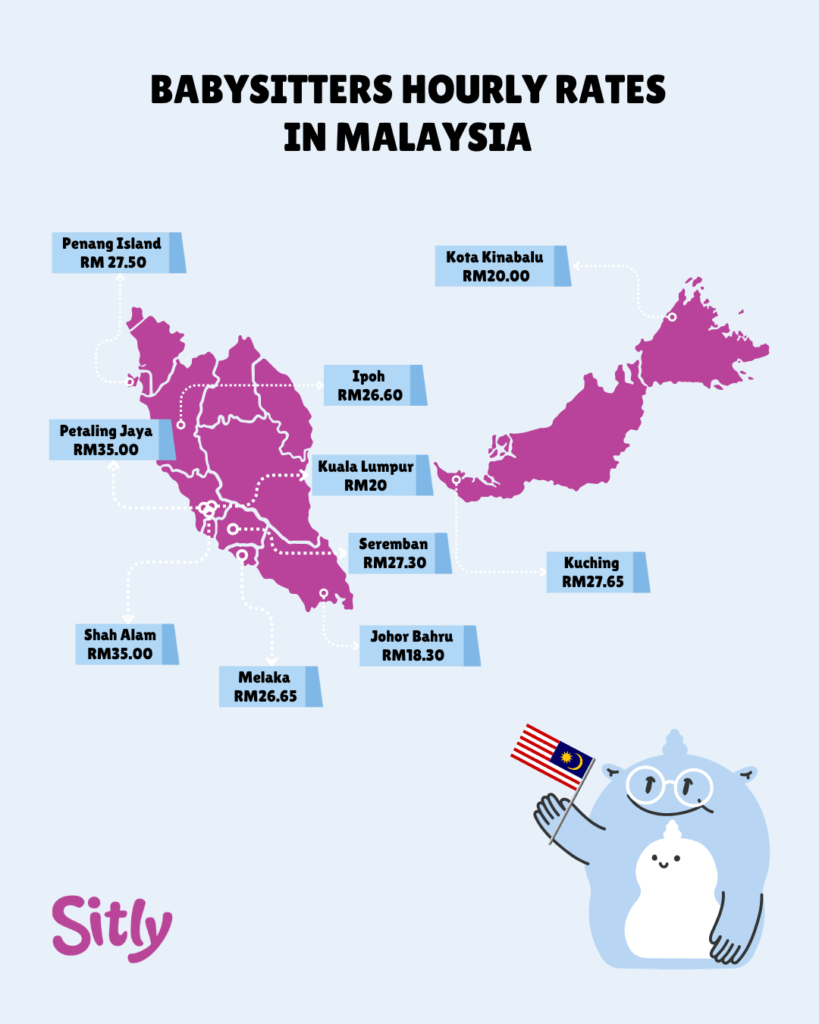
Average hourly babysitting rates in Malaysia
| City | Hourly Rate |
|---|---|
| Penang Island | RM27.50 |
| Petaling Jaya | RM35.00 |
| Shah Alam | RM35.00 |
| Melaka | RM26.65 |
| Seremban | RM27.30 |
| Johor Bahru | RM18.30 |
| Kuala Lumpur | RM20.00 |
| Ipoh | RM26.60 |
| Kota Kinabalu | RM20.00 |
| Kuching | RM27.65 |
Example: Babysitter (18 years old) – 3 Children + Dinner Prep
Sarah is 18 years old and has extensive babysitting experience. She recently started a teacher training programme and holds a pediatric CPR certification. Once a week, she works for a family with three children aged 8, 5, and 3. She arrives at 1:00 PM, picks up the older children along with the toddler from school, and brings them all home for snacks and playtime. The parents also appreciate it when she prepares dinner, so they can eat together when they return around 6:30 PM. What’s a Fair Rate for Sarah?
Breakdown of her rate:
RM 10.50/hour → Base rate, typical for students in suburban areas
+RM 5.00/hour → For managing two additional children
+RM 3.00/hour → For experience and CPR certification
= RM 18.50/hour
She works for 5.5 hours, so her pay is:
RM 18.50 × 5.5 = RM 101.75
Because Sarah also cooks dinner, the family rounds it up to a flat RM 102.00 — a fair and simple rate for both sides.
How to Calculate Your Babysitting Pay
Besides where you work, there are several other factors that can increase how much you earn as a babysitter. Your experience, qualifications, the number of children you look after, and any extra tasks you handle — all of these can affect your final hourly rate.
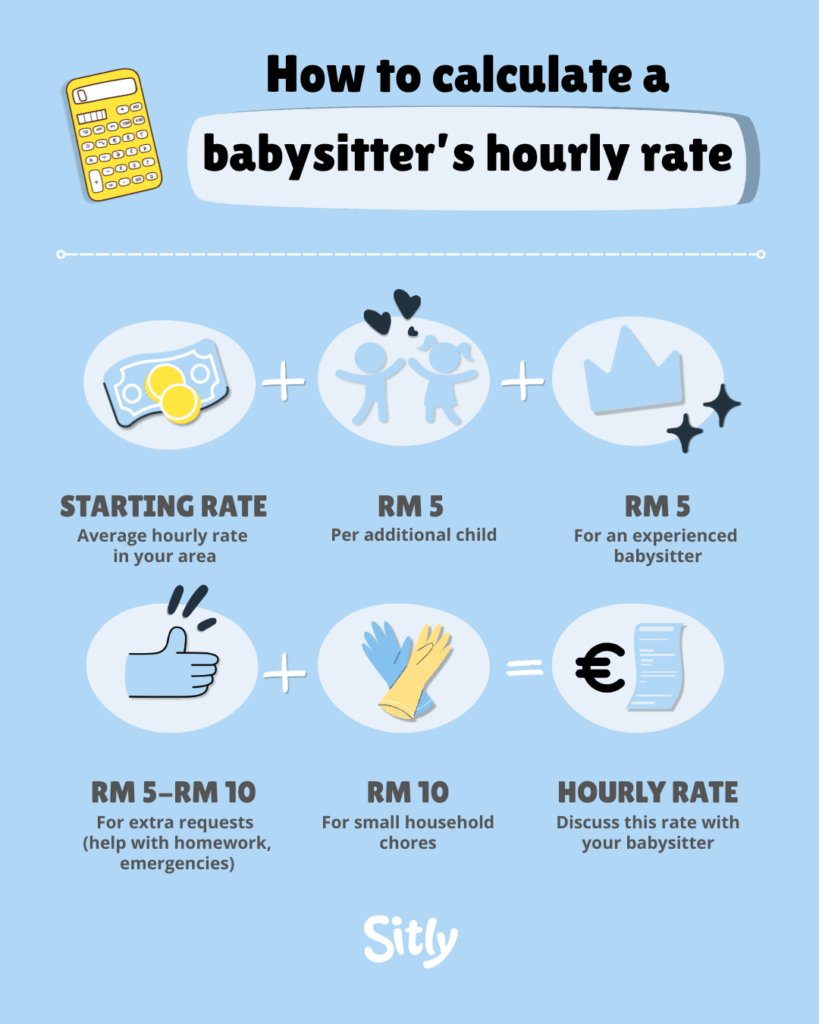
When calculating your babysitting pay, it’s important to look at the whole picture: not just the time you spend, but also the level of care and responsibility your job requires. The infographic below shows how to estimate your hourly babysitting rate realistically, based on your experience and the type of work you do for each family.
Infographic: Babysitter Pay Calculation
How Much Does an Experienced Babysitter Earn?
If you’ve been working with children for several years or have formal childcare training — for example, in early childhood education, nursing, or preschool assistance — you can confidently ask for a higher rate than the average. Families are usually willing to pay more when they see professionalism, reliability, and strong childcare skills.
Experienced babysitters in Malaysia often charge RM 25–35 per hour, especially in large cities or when caring for infants.
Babysitting Two or More Children
When you look after two or more children, it’s completely fair to charge more — usually 10–20% above your base rate, depending on the level of effort required. Caring for two young siblings, for example, takes much more attention than looking after one older child. And if the children are different ages, finding activities suitable for everyone can be even more demanding.
So if you normally charge RM 20 per hour, you could ask for around RM 25 per hour when caring for two kids, or more if the job involves extra coordination or physical effort.
Babysitting rate with Light Household Tasks
Tidying up the play area, washing the dishes used by the children, or preparing their meals are part of normal babysitting duties. However, if parents ask you to help with extra household chores — such as doing family laundry, vacuuming, or general cleaning — these tasks go beyond typical childcare work and should be paid separately. A RM 10 per hour increase is reasonable when you take on these additional responsibilities.
Babysitting rates with Driving or Pick-Ups
Many babysitters in Malaysia also handle school pick-ups or activity drop-offs. If you use your own car for these trips, you should agree on a transport allowance or fuel reimbursement, either weekly or monthly. This ensures you’re fairly compensated for petrol costs and time spent driving.
Evening or Overnight Babysitting rates
Evening babysitting is often paid a bit more because it involves less convenient hours and, sometimes, staying late or overnight. In general, you can ask for 10–20% more than your daytime rate when working after 10 p.m. or sleeping over. For instance, if your normal rate is RM 20 per hour, you can charge RM 22–24 for evening shifts — especially if you stay overnight or need to stay awake in case the children wake up.
However, if the children are already asleep and don’t need much attention, it’s fine to agree on a slightly lower rate for those hours. The key is to discuss expectations clearly before the job starts.
Safety Tip. If you finish work late at night, make sure to discuss your safety and transport home with the parents. Will they drive you back, pay for a Grab ride, or accompany you to your car? Your safety should always come first — and it’s something both you and the parents should agree on from the beginning.
Example: Babysitter (16 years old) – 2 Children, Weekend Evenings
Lia is a 16-year-old high school student. She has over two years of babysitting experience, mostly gained while looking after her younger brother and cousins. In her current babysitting arrangement, she occasionally cares for two children on weekend evenings. When she arrives at 7:30 PM, the kids are getting ready for bed. She stays until 11:30 PM, and the parents always drive her home. They also provide snacks and drinks, and ask her to wash a few dishes in the sink
What’s a reasonable rate for Lia?
RM 10.00/hour → Suggested rate for a teen babysitter with light duties
+RM 1.00/hour → For supervising a second child
= RM 11.00/hour
However, because the children are already asleep and the evening is very quiet, Lia and the parents agree on a flat rate of RM 10.00/hour.
Total pay: RM 10.00 × 4 hours = RM 40.00
Lia is very happy with the arrangement. It’s a calm evening, she feels trusted, and the rate matches the light responsibilities.
Babysitter Pay: Hourly or Fixed Rate — Which Is Better?
Should you charge by the hour or agree on a fixed monthly amount? It really depends on the type of work you do for each family. If you babysit occasionally or your hours change often, it’s best to charge an hourly rate — this way, you’re paid only for the exact hours you work. Hourly pay is fair, transparent, and works well when your schedule isn’t regular.
But if you work regularly with the same family, a fixed monthly or weekly rate can be more convenient for both sides. It gives you a predictable income and makes budgeting easier for the parents. If you agree on a fixed rate, be sure to define clearly what’s included:
- Will you still be paid if the family doesn’t need you one week?
- What happens if they ask you to stay longer than planned?
- How do you handle extra days in a longer month?
Discussing these details early helps avoid misunderstandings and keeps your relationship with the family professional and positive.
Last-Minute Babysitting or Emergency Calls
What if the family calls you at the last minute — for example, early in the morning because their child woke up sick? In these cases, it’s reasonable to ask for a slightly higher rate (10–20% more) to recognise your flexibility and short-notice availability.
It’s a good idea to agree in advance on a “last-minute rate”, so both you and the parents know what to expect when urgent situations come up.
This keeps things clear and ensures that your time and flexibility are fairly rewarded.
Example: Babysitter (21 years old) – 1 Child, After-School Care & Lunch Prep
Nina is 21 and currently studying Early Childhood Education. She holds a Child CPR certification and has a flexible class schedule this term. Every Wednesday afternoon, she babysits one child for a regular client. She picks up the 6-year-old boy from school at 12:00 PM, prepares lunch, plays with him, and stays until the parents return around 6:00 PM. The child is very active, so Nina stays engaged the entire time. The family provides all lunch supplies and reimburses small expenses like bus fare or extra snacks.
What’s a reasonable rate for Nina?
RM 17.00/hour → Typical rate for qualified babysitters in urban areas
+RM 1.00/hour → For CPR certification and formal training
+RM 1.00/hour → For high-energy care and full engagement
= RM 19.00/hour
She works for 6 hours, so the total is:
RM 19.00 × 6 = RM 114.00
The family rounds this to RM 115 and always provides lunch — a fair and transparent agreement that works well for both sides.
How Much Does a Babysitter Earn per Month?
Your monthly earnings as a babysitter in Malaysia depend on how many hours you work and your level of experience. A part-time babysitter working around 20 hours per week can typically earn between RM 1,200 and RM 2,000 per month.
If you work full-time and have childcare qualifications or experience caring for infants or children with special needs, your salary can reach RM 3,000–4,000 per month, or more in major cities. Some professional nannies who live with the family (live-in nannies) or take on wider household responsibilities can earn RM 4,500 and above, but those positions are usually formal employment arrangements with written contracts and regular contributions.
How Much Does a Babysitter Earn per Day?
If you babysit only on certain days — for example, during school holidays or when parents are away for work — you can agree on a daily rate instead of an hourly one.
The calculation is simple: multiply your hourly rate by the number of hours you work.
A full 8-hour day is usually worth RM 160–250, depending on your experience, the children’s ages, and the tasks involved. The amount can increase if you care for infants, prepare meals, or work into the evening.
Tip: Always discuss with the family in advance what your working hours, responsibilities, and overtime rules will be. If you’re asked to stay longer than planned, it’s best to have an agreed rate for those extra hours.
How can I calculate my babysitting rate fairly?
When deciding your rate, consider several key factors:
- Your experience and qualifications;
- The number and age of the children;
- The average rate in your area;
- The time of day you work (daytime, evening, or overnight);
- Any extra responsibilities like cooking, driving, or cleaning.
Once you’ve figured out what feels like a fair hourly rate, the next step is to discuss it openly with the parents. It can feel a little awkward at first, but being clear about pay from the start is the best way to avoid misunderstandings and build a good working relationship.
A good approach is to come prepared and informed: check what other babysitters in your area charge, and explain your rate calmly by mentioning your experience, working hours, or any extra duties.
You can also ask the family what rate they had in mind — that way, the conversation becomes an open, respectful discussion, making it easier to agree on a rate that feels fair to both sides.
Table of contents


FAQS

Hourly babysitting rates in Malaysia generally range from RM15 to 30 per hour, depending on the city, the babysitter’s experience, and the age of the child. Kuala Lumpur and other major urban areas tend to sit at the higher end of the range. Rates may increase during evenings, weekends, or urgent bookings.
Kuala Lumpur typically has the highest babysitting rates in the country because of demand and cost of living. Most babysitters in KL charge RM15 to RM30 per hour, with more experienced or certified babysitters charging even more. Prices can vary based on the number of children and care complexity.
Part-time babysitters usually charge RM12 to RM20 per hour for standard daytime care. For longer stays or full-day bookings, daily rates range from RM80 to RM150 per day. Some part-time babysitters also offer package deals for recurring weekly bookings.
Live-in babysitters or nannies typically receive a monthly salary between RM1,800 and RM3,000, depending on experience and responsibilities. Their compensation often includes meals, accommodation, and sometimes additional allowances for overtime, night care, or travel.
Yes. Caring for infants requires more attention, feeding, and specialized handling, so babysitters usually charge RM3 to RM10 extra per hour compared to regular child care. Infant-focused babysitters with training in newborn care or first-aid often command premium rates.


Flexible babysitting jobs, just around the corner
Love spending time with kids? Become a Sitly Sitter! We connect you with families looking for a reliable sitter. Set your own schedule, choose your rates, and meet families nearby. Get started today!

Related Articles

7 Tips for Writing a Babysitter Ad That Gets You Hired
Learn how to write a babysitter description that actually gets replies, with real examples of what to include and what to skip. From your bio to your photo, here's what makes parents stop scrolling and reach out.

Babysitter Contract: A Practical Guide for Parents and Babysitters
A babysitter contract sets clear expectations on pay, hours, and responsibilities and covers the smaller details that often cause friction later. In this guide, we walk you through everything you need to include, how to write it together, and what to keep in mind along the way. Plus, download a free babysitter contract template to get started straight away.

Calculate Your Babysitter’s Rate with the Sitly Calculator
Curious about how much to pay a babysitter in your area? Sitly’s Babysitter Rate Calculator helps you estimate a fair hourly rate based on your location in Malaysia, how many children you have, and any additional responsibilities. Get a clear, personalised idea of what families and babysitters typically agree on.